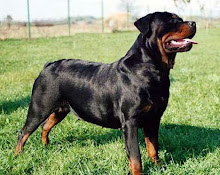
A Rottweiler is an ancient, noble breed that is thought to have originated with the Roman Army trying to create an all-purpose dog. The breed as we recognize it today arrived around 1910, appropriately enough, in the southern German area called Rottweil. Rottweilers are highly trainable, handsome dogs that look a lot fiercer than they are. They are easy to groom but require a lot of exercise. They are one of the perfect breeds of dogs for families with children, as Rottweilers bond better with kids than with adults.
Rottweilers average about one hundred pounds, although some specimens only tip the scales at seventy-five pounds. They can vary in size and amount of fluffiness, but have the same basic body shape and head shape. They have powerful, Mastiff-like muzzles with prominent teeth, large soft eyes and floppy ears. They are almost always black and tan, although some can be almost pure black. The allowed colors for the undercoat are grey, tan and black.
According to the breed standard, Rottweilers should be mostly black with rust-red points only. The points include the paws, legs, belly, chest, jaw, dots where their eyebrows would be, and underneath the tail. No white markings are allowed on show dogs. No dewclaws are allowed on show dogs (although rarely some puppies are born without them). They may have short coats or double costs, neither of which should be long or wavy.
Rottweilers should average about one hundred pounds and look solid as a rock. They should exude a sense of controlled power and be well muscled. These dogs can easily become overweight so it is important to monitor their diet and exercise. The ears should be floppy (but not as floppy as a Bassett Hound's – think floppy like a Jack Russell). The eyes should be brown. The expression should be soft, as a direct contrast to the massive jaws, which should meet evenly.
Rottweilers have to be shown with docked tails. According to Rottweiler information, the docked tail "honors the breed's special character". They are chopped off by the breeder and usually not by a veterinarian when the Rottweiler puppies are two or three days old, when the bones are still soft. In England, all Rottweilers born after April 2007 must be shown with natural, long, curving tails, as docking has finally been banned.
Rottweilers are alert, curious and highly trainable. They will eagerly try anything you want them to do, from guard work, catching a tennis ball to acting in movies. When they are not overfed and under-exercised, they are calm characters, as steady as the black and tan rocks they look like. It is important to keep them exercised. A good Rottweiler is a tired Rottweiler. They also are calmer, healthier and less likely to roam or pick a fight with another dog if neutered.
It is hoped that the Rottweiler breed standard will be changed to ban all tail docking. You can find many books in your local library that are full of Rottweiler information.
Showing posts with label Rottweiler. Show all posts
Showing posts with label Rottweiler. Show all posts
Monday, April 21, 2008

Monday, April 14, 2008
Think Carefully Before Getting Rottweiler Dogs
A lot of work has to go into a relationship between a Rottweiler and his or her human. Usually, they both need training. There is no need to resort to training gimmicks like shock collars or prong collars with most Rottweilers. They will only scare Rottweiler dogs, not make them dependable. With a dog so large and strong, even a terrified Rottweiler may accidentally hurt someone. On average, Rottweiler dogs weigh eighty pounds when full grown, with some males tipping the scales at over one hundred pounds.
A lot of that weight is due to the size of their hearts – well, not really, but they seem to have huge hearts. Rottweiler dogs are affectionate, loyal and great with kids if given a fair shake. They need proper nutrition and a close eye on their diets so they do not get too fat or too hyper. They need a lot of daily exercise of at least one hour a day, preferably more. This can include walks, playing fetch, playing games or running about the yard. You need to make a commitment to taking care of a Rottweiler in the way you would have to care for a pony.
Rottweiler dogs go crazy when left all by themselves, such as when they are chained in someone's back yard as a cheap security system. If they do not get proper exercise, they will find ways of burning up their considerable energy, including destroying your home. These are not dogs that can be left alone in your home while you are at work unless they are given fun activities to do while you are away and given long walks.
Be choosy in selecting the Rottweiler information about care and training that you want to follow. Anyone who says to beat the dog or use shock collars have no idea what they are talking about. A frightened dog is far more dangerous than an angry one. Rottweiler dogs have been bred to be active all day and this has not been bred out of them. Rottweilers need positive reinforcement, praise and consistent commands.
Another reason Rottweiler dogs get abandoned is due to their health. Rottweiler dogs are not as prone to illnesses like some other breeds, but they need their diets and exercise monitored, especially as puppies. Too much food or too little exercise can damage the growing Rottweiler's skeleton and joints. Rottweilers of all ages are prone to hip or elbow dysplasia, which is curable, but costly. Most people would rather buy a new car than pay for their dog's veterinary bills.
Rottweiler dogs have big appetites and will cost more to feed than some other breeds of dogs. They will need at least once a year check-ups and booster shots. They need to be licensed, micro chipped and given obedience training. Most people are very ignorant on their Rottweiler information and will sooner shoot a Rottweiler running towards them than welcome them with open arms (which is what most Rottweilers expect). Rottweilers need to be on leads in the public at all times.
The Rottweiler has a reputation it does not deserve. With more Rottweiler information available to the general public, there will be fewer Rottweilers abandoned.
A lot of that weight is due to the size of their hearts – well, not really, but they seem to have huge hearts. Rottweiler dogs are affectionate, loyal and great with kids if given a fair shake. They need proper nutrition and a close eye on their diets so they do not get too fat or too hyper. They need a lot of daily exercise of at least one hour a day, preferably more. This can include walks, playing fetch, playing games or running about the yard. You need to make a commitment to taking care of a Rottweiler in the way you would have to care for a pony.
Rottweiler dogs go crazy when left all by themselves, such as when they are chained in someone's back yard as a cheap security system. If they do not get proper exercise, they will find ways of burning up their considerable energy, including destroying your home. These are not dogs that can be left alone in your home while you are at work unless they are given fun activities to do while you are away and given long walks.
Be choosy in selecting the Rottweiler information about care and training that you want to follow. Anyone who says to beat the dog or use shock collars have no idea what they are talking about. A frightened dog is far more dangerous than an angry one. Rottweiler dogs have been bred to be active all day and this has not been bred out of them. Rottweilers need positive reinforcement, praise and consistent commands.
Another reason Rottweiler dogs get abandoned is due to their health. Rottweiler dogs are not as prone to illnesses like some other breeds, but they need their diets and exercise monitored, especially as puppies. Too much food or too little exercise can damage the growing Rottweiler's skeleton and joints. Rottweilers of all ages are prone to hip or elbow dysplasia, which is curable, but costly. Most people would rather buy a new car than pay for their dog's veterinary bills.
Rottweiler dogs have big appetites and will cost more to feed than some other breeds of dogs. They will need at least once a year check-ups and booster shots. They need to be licensed, micro chipped and given obedience training. Most people are very ignorant on their Rottweiler information and will sooner shoot a Rottweiler running towards them than welcome them with open arms (which is what most Rottweilers expect). Rottweilers need to be on leads in the public at all times.
The Rottweiler has a reputation it does not deserve. With more Rottweiler information available to the general public, there will be fewer Rottweilers abandoned.
Tuesday, April 8, 2008
History Of The Rottweiler
The Rottweiler was registered by the American Kennel Club in 1935 and is classified in the working dog group. This breed has been renowned historically for its ability to guard, protect and herd. Unfortunately, the Rottweiler dog breed in recent years has developed the reputation of being aggressive and prone to violence. A large, strong dog, the Rottweiler can certainly be a formidable opponent. Its ancestry may help explain how it developed its good and bad reputation.
The modern day Rottweiler was named after Rottweil, Germany where it gained support in the early 1900s. Prior to that date, Rottweilers have an uncertain lineage though the common belief is that they descended from the large Roman mastiff dog almost two thousand years ago. Even then, early forms of Rottweiler were known for their skill in protection and military service. The inherent intelligence and strength of the breed allow these dogs to be trained in many tasks and the Roman army utilized Rottweilers in conquering Europe. The protective nature of the breed can manifest itself in aggression if Rottweilers are not trained from an early age. Some owners take advantage of that aggression or mistreat dogs so that these tendencies come out.
The personality and appearance of the Rottweiler dog breed make it unique.
Surprisingly, one of the first adjectives used to describe the Rottweiler's personality is calm. The breed is known to be an excellent, relaxed family pet. In fact, a calm, courageous and confident temperament is the breed standard according to the American Kennel Club, which registered the Rottweiler in 1935. Other personality traits include loyalty to family but aloofness with strangers, intelligence, work ethic and self-assuredness. All of these traits assist the Rottweiler dog in performing the tasks it does best such as herding, protecting, tracking, competing, and performing police and military work.
The Rottweiler's strong physical traits also define the breed. All purebred Rottweiler's have distinctive coloring with an all black short coat with brown markings in specific areas of the cheeks, muzzle, paws and legs. A strong and large dog, the Rottweiler is muscular and has a broad head and chest. Its tail is generally docked to give its body a longer, more streamlined appearance. Rottweilers are easily differentiated from other dog breeds due to their physical and personality traits.
There is no guarantee that a mistreated Rottweiler dog won't become aggressive in the future. Even if the dog has been rescued and re-socialized by a rescue center, the potential for violence will always be there. It is normally recommended that potential dog owners check into adopting or fostering rescued purebreds from shelters rather than buying purebred puppies. However, this is not a good option with the Rottweiler dog because of its size and potential for aggressive behavior if it feels threatened.
When buying a purebred Rottweiler, it is a good idea for the buyer to visit the kennel and see how puppies are raised. If Rottweilers receive love and training from an early age they will have a good foundation for the buyer to build upon. Researching breeders to make sure they are ethical is also important. Buyers should know the breed standard for Rottweiler dogs and should look for the calm temperament, specific black and tan markings and other characteristics unique to the breed. Most importantly, the buyer's household should meet the Rottweiler's social and activity needs so that dog and owner will have a healthy, happy life together.
A Rottweiler dog is known for personality traits such as loyalty, confidence and aloofness. However, when mistreated, a Rottweiler's inherent protective nature can manifest in aggressive and violent behavior. Rottweiler information and history is provided in this article. The Rottweiler dog's physical and behavioral traits are also described.
The modern day Rottweiler was named after Rottweil, Germany where it gained support in the early 1900s. Prior to that date, Rottweilers have an uncertain lineage though the common belief is that they descended from the large Roman mastiff dog almost two thousand years ago. Even then, early forms of Rottweiler were known for their skill in protection and military service. The inherent intelligence and strength of the breed allow these dogs to be trained in many tasks and the Roman army utilized Rottweilers in conquering Europe. The protective nature of the breed can manifest itself in aggression if Rottweilers are not trained from an early age. Some owners take advantage of that aggression or mistreat dogs so that these tendencies come out.
The personality and appearance of the Rottweiler dog breed make it unique.
Surprisingly, one of the first adjectives used to describe the Rottweiler's personality is calm. The breed is known to be an excellent, relaxed family pet. In fact, a calm, courageous and confident temperament is the breed standard according to the American Kennel Club, which registered the Rottweiler in 1935. Other personality traits include loyalty to family but aloofness with strangers, intelligence, work ethic and self-assuredness. All of these traits assist the Rottweiler dog in performing the tasks it does best such as herding, protecting, tracking, competing, and performing police and military work.
The Rottweiler's strong physical traits also define the breed. All purebred Rottweiler's have distinctive coloring with an all black short coat with brown markings in specific areas of the cheeks, muzzle, paws and legs. A strong and large dog, the Rottweiler is muscular and has a broad head and chest. Its tail is generally docked to give its body a longer, more streamlined appearance. Rottweilers are easily differentiated from other dog breeds due to their physical and personality traits.
There is no guarantee that a mistreated Rottweiler dog won't become aggressive in the future. Even if the dog has been rescued and re-socialized by a rescue center, the potential for violence will always be there. It is normally recommended that potential dog owners check into adopting or fostering rescued purebreds from shelters rather than buying purebred puppies. However, this is not a good option with the Rottweiler dog because of its size and potential for aggressive behavior if it feels threatened.
When buying a purebred Rottweiler, it is a good idea for the buyer to visit the kennel and see how puppies are raised. If Rottweilers receive love and training from an early age they will have a good foundation for the buyer to build upon. Researching breeders to make sure they are ethical is also important. Buyers should know the breed standard for Rottweiler dogs and should look for the calm temperament, specific black and tan markings and other characteristics unique to the breed. Most importantly, the buyer's household should meet the Rottweiler's social and activity needs so that dog and owner will have a healthy, happy life together.
A Rottweiler dog is known for personality traits such as loyalty, confidence and aloofness. However, when mistreated, a Rottweiler's inherent protective nature can manifest in aggressive and violent behavior. Rottweiler information and history is provided in this article. The Rottweiler dog's physical and behavioral traits are also described.
Wednesday, March 5, 2008
Reading Up On Rottweiler History
There is little doubt in the mind of anyone who comes across the impressive Rottweiler that they appear to be a force that you do not want to go against. And that fear and respect is justified by not only the actions of the dog today, but also what this Rottweiler breed has done for people throughout the ages. In order to get a good idea of how important, smart and dedicated your Rottweiler can be, it is important to understand the history behind this breed.
You may be surprised to learn that this breed didn't come about as a mistake and that these dogs seemed to always have their place in society and were used to help their human owners in work and protection. By learning about the history of this breed, you may be better suited to understand what is going on behind that soft and gentle look on your dog's face which is incased in a more rough and tumble exterior. By opening up, you may be surprised at what you will learn.
This breed is not one that just came about, as the ancestry of the Rottweiler dates back into ancient Roman times, which started with a type of Mastiff dog known as the Roman drover. These dogs were used daily to herd cattle during the time that the army would be traveling. And then during the night the drovers would be left to watch over the soldiers while they slept and would alert them if troubled surfaced.
But it was during the travels of Caesar that some of the drovers were left in areas of Germany and natives there adopted them. The Germans ended up breeding the dogs to help them with jobs that they needed help with since this breed did so well for the soldiers. It was actually in the town of Rottweil, Germany where this breed got its name, as this is the place where the dog became known as the butcher's dog.
While it seemed a natural choice to use the Rottweiler to pull carts and barges, the railroad soon came through and replaced the dogcarts. This advancement in travel left the Rottweiler without a job and the future was not looking good for the breed. That is until 1910 when the police officially recognized the Rottweiler as a police dog. Not only did the Rottweiler serve its country on the streets with police, but also they served their time in World War II when the Nazis and the Allies utilized their great strength and loyalty.
Then finally, in 1931, the American Kennel Club Stud Book admitted the first Rottweiler. The popularity of the Rottweiler had been growing for a decade, as the Rottweiler has come in on the American Kennel Club 's top ten registered breeds. But even though in the year 2000, the Rottweiler slipped into eleventh place, the breed still is one of the most popular dogs to date and with the history that is behind this dog, there is no wonder as to why.
There is often times fear and misunderstanding when it comes to the Rottweiler. Rottweiler lovers worldwide are passionate about trying to make sure that more people understand the history of the Rottweiler. The Rottweiler is much more then a dumb guard dog as this breed is dedicated to their owners, not out of ignorance but out of love and respect. A lot of Rottweiler information can be found in different books or just by talking with your vet.
You may be surprised to learn that this breed didn't come about as a mistake and that these dogs seemed to always have their place in society and were used to help their human owners in work and protection. By learning about the history of this breed, you may be better suited to understand what is going on behind that soft and gentle look on your dog's face which is incased in a more rough and tumble exterior. By opening up, you may be surprised at what you will learn.
This breed is not one that just came about, as the ancestry of the Rottweiler dates back into ancient Roman times, which started with a type of Mastiff dog known as the Roman drover. These dogs were used daily to herd cattle during the time that the army would be traveling. And then during the night the drovers would be left to watch over the soldiers while they slept and would alert them if troubled surfaced.
But it was during the travels of Caesar that some of the drovers were left in areas of Germany and natives there adopted them. The Germans ended up breeding the dogs to help them with jobs that they needed help with since this breed did so well for the soldiers. It was actually in the town of Rottweil, Germany where this breed got its name, as this is the place where the dog became known as the butcher's dog.
While it seemed a natural choice to use the Rottweiler to pull carts and barges, the railroad soon came through and replaced the dogcarts. This advancement in travel left the Rottweiler without a job and the future was not looking good for the breed. That is until 1910 when the police officially recognized the Rottweiler as a police dog. Not only did the Rottweiler serve its country on the streets with police, but also they served their time in World War II when the Nazis and the Allies utilized their great strength and loyalty.
Then finally, in 1931, the American Kennel Club Stud Book admitted the first Rottweiler. The popularity of the Rottweiler had been growing for a decade, as the Rottweiler has come in on the American Kennel Club 's top ten registered breeds. But even though in the year 2000, the Rottweiler slipped into eleventh place, the breed still is one of the most popular dogs to date and with the history that is behind this dog, there is no wonder as to why.
There is often times fear and misunderstanding when it comes to the Rottweiler. Rottweiler lovers worldwide are passionate about trying to make sure that more people understand the history of the Rottweiler. The Rottweiler is much more then a dumb guard dog as this breed is dedicated to their owners, not out of ignorance but out of love and respect. A lot of Rottweiler information can be found in different books or just by talking with your vet.
Subscribe to:
Posts (Atom)